


Advanced Wastewater Treatment Technologies
Huachuang Environmental Group specializes in the research and development of high-efficiency industrial and municipal wastewater treatment technologies, along with comprehensive upstream and downstream process management. Our expertise lies in designing and implementing customized treatment solutions tailored to regional characteristics, effectively addressing complex wastewater treatment challenges.
Technologies & Processes
IBR Technology (Integrated Batch Reactor)
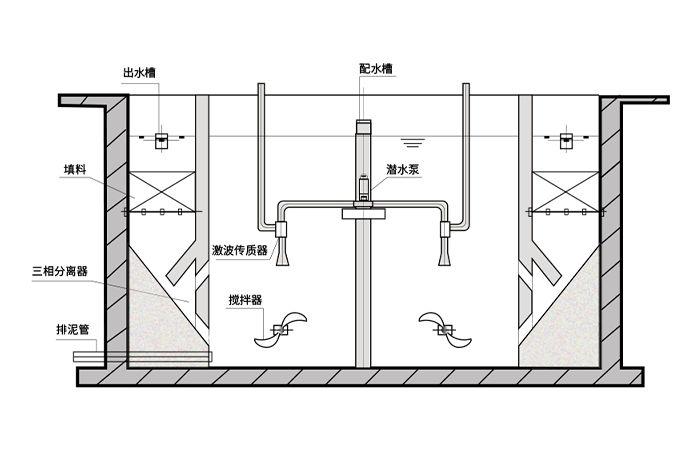
IBR (Integrated Batch Reactor) technology is a continuous cyclic activated sludge process, integrating anaerobic, anoxic, aerobic, and sedimentation phases within a single reactor. By adjusting the aeration-to-rest ratio, the system establishes multi-stage aerobic, anoxic, and anaerobic conditions, optimizing the removal of nitrogen and phosphorus from wastewater. The only internal mechanical components are submersible pumps and mixers, reducing operational complexity.
Key Advantages:
High volumetric load & shock resistance– Efficient treatment in a compact footprint.
High microbial activity– Maintains high microbial concentration for enhanced biodegradation.
Low sludge yield– Eliminates the need for sludge recycling.
Stable and high-quality effluent– Ensures regulatory compliance.
Low energy consumption– Cost-effective operation.
No sludge bulking issues– Ensures consistent system stability.
Technologies & Processes
Rotating Biological Contactor (RBC) Process
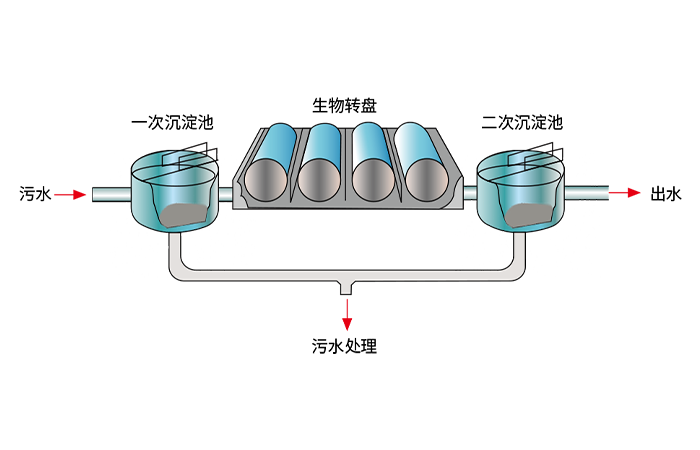
The Rotating Biological Contactor (RBC) process is a biological film-based wastewater treatment technology, which enhances wastewater purification through biofilm development. Microorganisms, including bacteria, fungi, protozoa, and other microbial species, grow on rotating disc media to form a biofilm layer. After primary sedimentation, wastewater contacts the biofilm, where microorganisms metabolize organic pollutants, achieving effective wastewater treatment.
Key Advantages:
Compact and efficient – High volumetric load & resistance to fluctuations.
Enhanced microbial activity – Maintains a stable biofilm for continuous treatment.
Low sludge production – Eliminates sludge recycling requirements.
Stable effluent quality – Ensures regulatory compliance.
Energy-efficient – Low power consumption and operational costs.
Intermittent operation capability – Flexible system operation.
No sludge bulking issues – Maintains process stability.
Technologies & Processes
Contact Oxidation Process
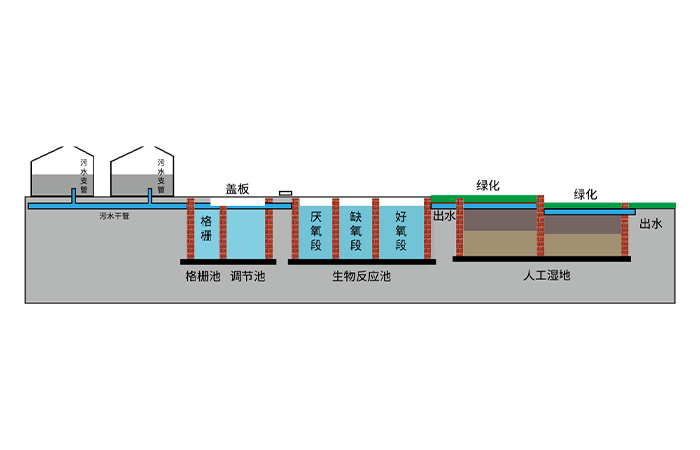
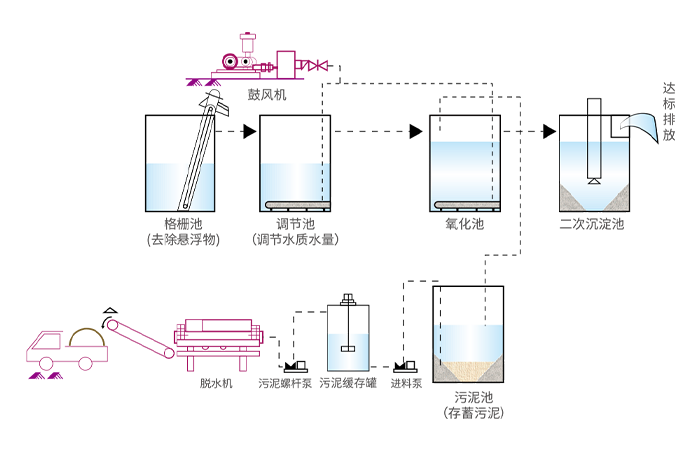
The Contact Oxidation Process is a hybrid biological wastewater treatment method, combining elements of activated sludge and biofilm technologies. The system employs an aeration tank filled with submerged media (e.g., coke, gravel, plastic honeycomb structures) to support microbial biofilm growth. Aeration is achieved through bottom-mounted blowers, promoting oxygen diffusion and microbial activity. The biofilm continuously absorbs and degrades organic pollutants, enhancing purification efficiency.
Key Advantages:
High load capacity & shock resistance – Efficient for high-strength wastewater in a compact space.
Enhanced biofilm activity– High microbial density ensures effective organic degradation.
Stable effluent quality– Consistently meets discharge standards.
Adjustable aeration– Optimized oxygen supply reduces energy costs.
Easy biofilm formation– Supports short-term intermittent operation.
Low sludge yield & no bulking– Minimal sludge production ensures stable performance.
Technologies & Processes
Oxidation Ditch Process
The Oxidation Ditch Process is an advanced modified activated sludge treatment system, widely adopted for municipal and industrial wastewater treatment. The system consists of a closed-loop aeration channel, forming a continuous-flow biological reactor. Unlike conventional activated sludge systems, the oxidation ditch operates in a circulating flow mode, promoting extended hydraulic retention and high oxygen transfer efficiency.
Key Advantages:
Handles high-strength wastewater – Suitable for municipal and industrial applications.
Excellent shock load resistance– Maintains stable effluent quality under varying influent conditions.
High BOD removal efficiency– Achieves up to 99% reduction under optimal conditions.
Optimized for nitrogen removal– Phosphorus reduction with additional treatment.
Reduces sludge production – Primary sedimentation may not be required in certain setups.
Simplified sludge management – Low maintenance and operational complexity.
Cost-efficient operation– Reduces long-term sludge treatment needs.


